DESS CO is a small, engineer-owned shop out of the Mountain West building BESS containers for the projects the Tier-1 vendors keep ghosting — co-ops, municipals, military sites, and the "too small to bother with" commercial jobs. We design it, we stamp it, we wire it, we energize it. Same crew, start to finish.
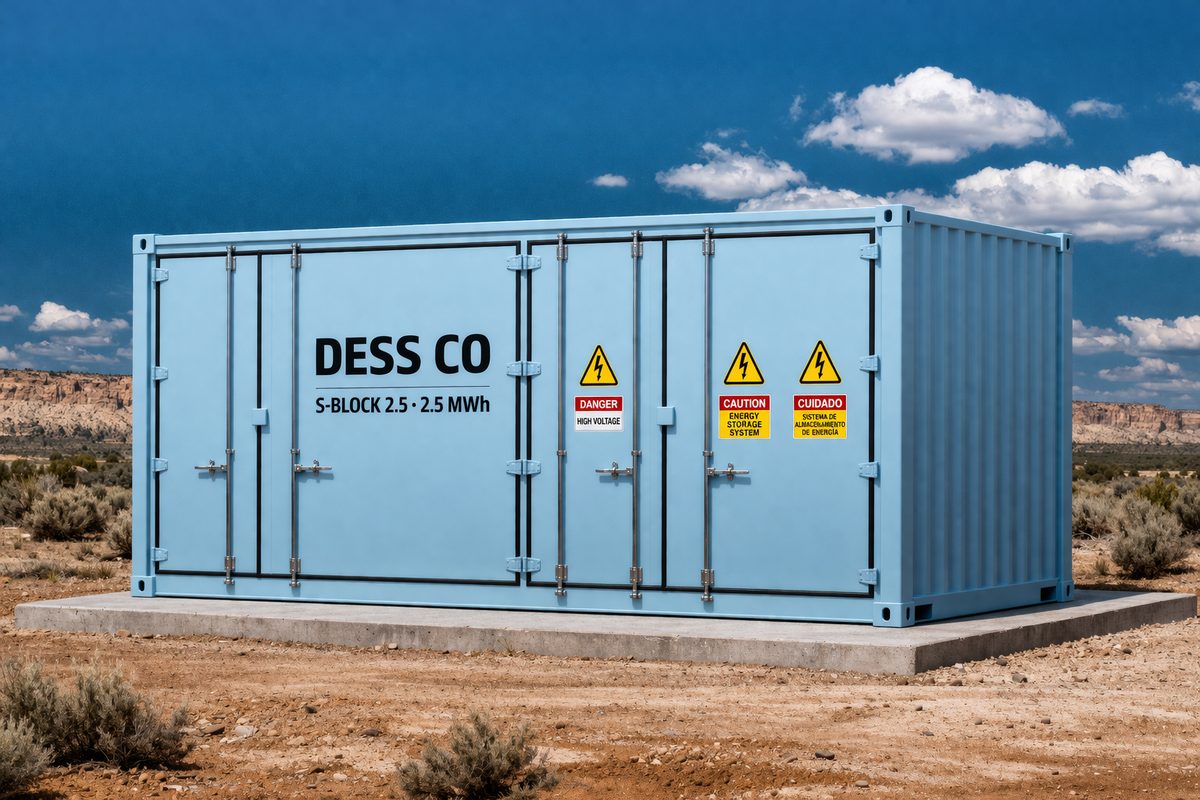
DESS CO brings PE-sealed engineering, electrical contracting, and commissioning under one roof. Same engineers draw it, same electricians wire it, same crew shows up for startup. When a question comes in at 2 a.m., you call the person who built it — direct.
No drop-shipped engineering from a contract shop in another state. The PE who sealed your one-line is the same one who'll pick up the phone when the AHJ has a question during plan review.
Full-time Journeyman and Master Electricians, licensed in CO and NM, on payroll year-round. We know what they're good at and where they need a second set of eyes — because we've worked with them for years, not days.
LG LFP cells out of Holland, MI. US-built PCS. Domestic steel container. It qualifies for the 10% ITC domestic content adder — and more importantly, we can drive to the cell factory if we need to.
Fike Blue suppression, Bender insulation monitoring on every string, NFPA 69 forced ventilation, and deflagration vent panels — engineered in from day one on every build.
It's a 30-foot custom enclosure with 6.6 MWh of LFP cells, four SiC inverters, and a fire suppression system we picked because it's the only one we'd actually trust around our own crew. Here's what's inside — and why we picked each piece.
30-ft custom enclosure · 4-hour duration · Medium-voltage interconnection
FEOC-compliant cells manufactured in Holland, Michigan. UL 1973 listed with 6,000+ cycle life at 80% depth of discharge. Thermal runaway onset at ~270°C.
4× modules at 537 kVA each delivering 2.148 MVA total. Silicon carbide topology for higher efficiency, lower losses, and reduced cooling requirements.
UL-Recognized BMS with cell-level voltage monitoring (±1 mV), multi-stack control, passive balancing, and functional safety certification to UL 991/1998.
The first third-party tested system proven to suppress both fire AND cascading thermal runaway. Paired with deflagration vent panels and NFPA 69 forced ventilation.
Precision thermal management maintaining ±3°C uniformity across all 18 racks. Optimizes cycle life and ensures peak performance in desert and mountain climates.
Modbus TCP, DNP3, and SunSpec protocols. Remote monitoring, dispatch optimization, predictive maintenance, and full utility SCADA integration.
Pad-mount step-up transformer, 600V AC bus with UL 508A switchgear, independent DC combiner boxes with Bender iso685-S insulation monitoring per string.
The container is the product, but it's not the whole job. Most of our weeks are spent in AutoCAD, on-site with a megger, or on the phone with a utility planner trying to get an interconnection moved up by three weeks. Here's the work we sign our name to.
Full design packages from the napkin sketch all the way to as-builts. If it has a battery and a transformer, we can draw it, stamp it, and defend it in a plan review meeting.
Distribution and small substation work — the kind of jobs the big EPCs price themselves out of. Pad design, grounding grid, MV gear, the whole bit. We've done dozens of them.
Arc flash, short circuit, coordination — the studies that get skipped until an inspector flags them. We run them in SKM and ETAP and we'll walk the AHJ through the results ourselves.
If there's already a PV array on the site, we'll design the storage to live next to it without blowing up the interconnection agreement. Most of our BESS projects start as "can you co-locate with our existing solar?"
The unsexy part nobody wants to talk about. We'll cycle the system, watch the data, write the punch list, and come back when something throws a fault code six months later.
Solar + battery + diesel for the places where the grid doesn't reach or can't be trusted. We've built these for remote pumping stations, off-grid ranches, and one very stubborn ham radio repeater.
We've done this enough times to know where projects get stuck. Most of the schedule risk lives in steps 3 and 5 — the utility and the AHJ — and we plan around that from day one. Here's the actual sequence.
Geotechnical evaluation, foundation design, reinforced concrete pad, and site grading per ASCE 7 seismic and wind requirements.
Crane operations, container rigging, precision placement on prepared foundations. Anchor bolt installation and seismic restraint verification.
Pad-mount transformer installation, MV cable termination, switchgear connection, protective relay programming. Full utility coordination through NTP.
600V AC bus wiring, DC combiner box connections, PCS commissioning, BMS communication verification, Megger insulation resistance testing.
Fire suppression functional test, gas detection calibration, e-stop chain verification, ventilation system commissioning, NFPA 70E arc flash labeling.
Full charge/discharge cycling, round-trip efficiency measurement, load bank testing at 25/50/75/100%, SCADA integration, utility witness test, and handoff.
DESS CO manufactures, tests, and ships its BESS containers anywhere in the continental US. We perform turnkey installation and commissioning in states where we hold an Electrical Contractor license (CO, NM, UT — AZ pending). For projects outside those states, we deliver the finished, PE-sealed system and either bring in a trusted local licensed EC partner, or work alongside the contractor your project already has straight through commissioning and energization.
Our own field crews are permanent, full-time employees — State Licensed Journeyman and Master Electricians. Every project is fully insured with comprehensive "Ultra" liability coverage.
Every DESS CO system is engineered from day one for UL listing, NEC compliance, and NFPA 855 fire safety. Not retrofitted. Not bolted on. Built in from the architecture up.
NRTL-certified system-level safety evaluation — electrical, mechanical, thermal, and fire protection.
Four-level thermal runaway fire propagation testing — cell, module, unit, and installation level.
Fire detection, suppression, explosion control, ventilation, and emergency response planning.
Complete disconnecting means, maintenance segmentation, emergency shutdown, and exterior labeling.
Fike Blue suppression + thermal barriers + forced ventilation below 25% LEL per NFPA 69.
PPM-level gas detection providing minutes of advance warning before thermal events propagate.
Non-prohibited battery entity cells eligible for full ITC under OBBBA legislation.
Smart inverter grid-support functions, ride-through, anti-islanding, and ramp rate control.
We target the underserved markets where the big OEMs don't show up — rural co-ops, municipal utilities, remote installations, and critical commercial facilities.
ITC-eligible, turnkey BESS for co-ops transitioning wholesale power contracts and joining organized markets. Sized right for distribution-level deployment at substations serving rural communities.
Peak shaving, demand charge management, and backup power for commercial facilities, data centers, and industrial operations. Custom-engineered for each site's specific load profile and rate structure.
Solar + storage + generator hybrid systems for remote communities, mining operations, military installations, and critical infrastructure requiring BABA compliance and energy independence.
If you're a co-op GM, a city engineer, or a developer who's been quoted "we'll get back to you next quarter" by the big vendors — send us the one-line. We answer our own phone and we'll tell you in a week whether we can help.
Or a sketch on a napkin, or a forwarded email from the utility, or whatever you've got. Real people read these — usually within a few hours during the workday, by the next morning if it's late.
Nickolas Eubanks: (725) 314-6644
Dan King: (970) 946-3281
Aztec, New Mexico
Monday – Friday: 8 AM – 5 PM
Emergency services available 24/7